Marketers are now worth more than engineers. I'm an engineer with 6 products and $0. Here's my 6-month plan.
X is arguing that marketers are now worth more than engineers. I'm the engineer in that sentence: six-plus products, $0 revenue. My eight distribution mistakes, ranked, and the 6-month plan to fix it in public.
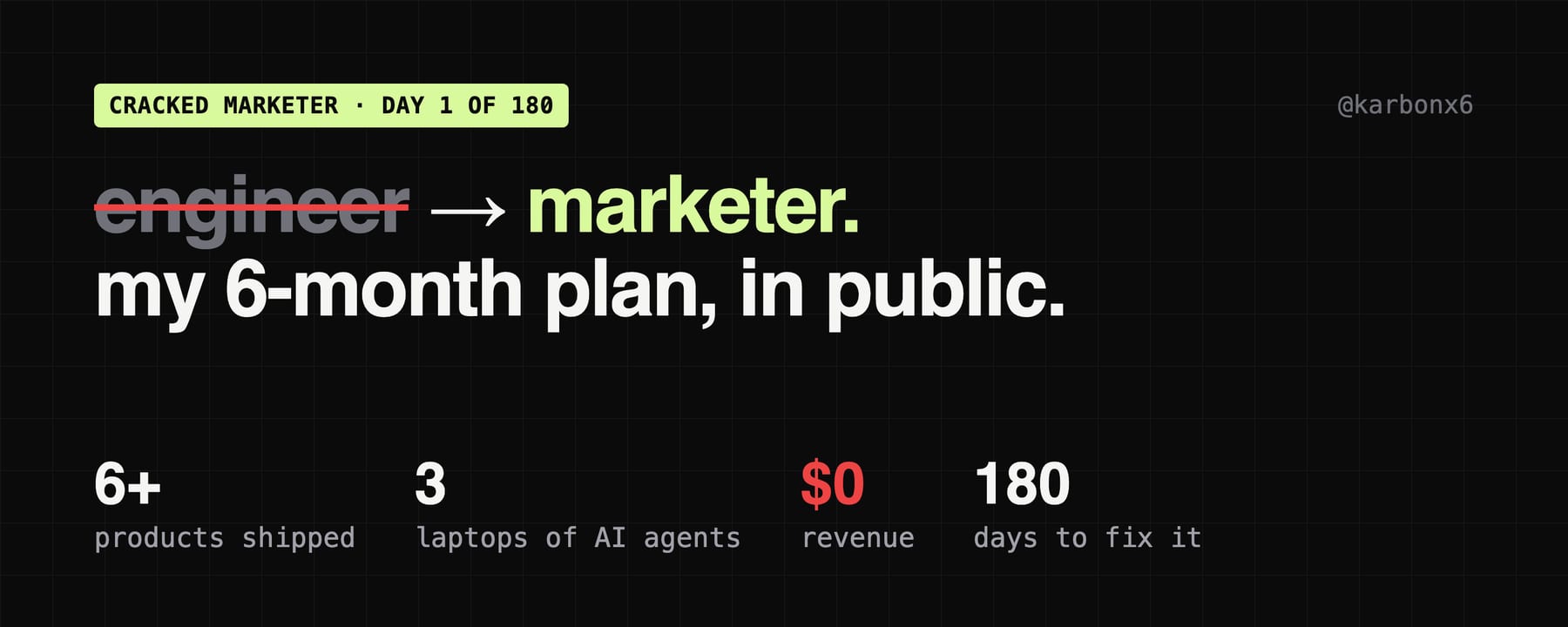
X is arguing about it today: marketers are now worth more than engineers.
I'm the engineer in that sentence. I've built six-plus products in the last year: an AI French tutor, a video tool that cuts your "um"s, a social media scheduler that posts from ChatGPT, a browser game, a 3D "yearbook" for SaaS founders, a few iPhone apps. Three laptops in my apartment run AI agents for them around the clock.
Combined revenue: $0.
So I'm not here to argue. The trend is right, and I'm the proof. For the next 6 months I'm going to fix it in public: learn distribution, post every lesson with the real numbers, and talk to real people every day, even when the product is rough.
This is the plan, starting with what I got wrong.
Why the trend is right
AI didn't make building easy. It made building cheap.
When anyone can ship an app in a weekend, the app stops being the hard part. The hard part is the thing I skipped every time: getting a stranger to care. Engineers who learn that skill are going to be rare and expensive. Engineers who don't are going to keep building beautiful things nobody sees. I've been the second kind.
My distribution mistakes, ranked
Every number below comes from my own projects. Nothing is rounded up.
1. I built the checkout before anyone wanted to buy
I built a 3D yearbook where SaaS founders buy 24-hour spots, $5 to $20. I wrote end-to-end tests that pushed 100 placements through the payment system at once.
Real buyers: 0. The 100 placements were all test data.
Lesson: get one person to say "I'd pay for that" before you write the payment code.
2. I scattered instead of shipping
At one point one product existed as about 14 copies across my laptops. I planned 4 iPhone apps for a phone launch; 1 got close to the App Store, 3 never started.
Lesson: one product, one channel, one month. Breadth feels like progress. It isn't.
3. I stopped showing up, and so did everyone else
My French app's Discord got 76 members, 52 of them in the first 48 hours. Then I watched the numbers: only 13 people ever typed anything. I posted 41 messages in launch week, then 1 the next week, then 0. Member activity fell in exactly the same pattern.
Lesson: in a small community, the founder is the engine. If you go quiet, it goes quiet.
4. I believed my analytics
My newest site got 108 visits in its first two days. Exciting, until I split them: 43 were vulnerability scanners looking for my .env file, 45 were other bots, 14 were humans.
Lesson: raw pageviews overstate real interest by about 7x. Only count humans, and only trust visits you can trace to a channel.
5. I talked to the wrong audience
I have about 3.5k followers on X. My game's own marketing notes say it plainly: "my followers are devs, not buyers." I posted 22 times in two days across Instagram, YouTube and TikTok and streamed to zero viewers.
Lesson: an audience is only useful if the buyers are in it. Pick the buyer first, then go where they are.
6. I had broken doors and never checked
- The "Add to Chrome" button on my site linked to a dead extension. Every click was lost.
- My waitlist form said "success" without saving the email.
- My support email bounced for weeks because the domain had no mail record.
Lesson: once a week, go through your own funnel like a stranger would. Click everything.
7. Platforms said no on launch day
My TikTok posts went out private because the app wasn't approved yet. My ChatGPT app was rejected on its first review.
Lesson: start every platform review weeks before you need it. Approval is part of the launch.
8. My AI agents did the work. I didn't press send.
This week my agents wrote 12 genuinely good Reddit replies. I posted 0. They found about 150 leads; most are still sitting at "new".
Lesson: the bottleneck was never the work. It's the human willing to put it in front of people.
The 6-month plan
Starting now, until May 2027:
- One insight a day. Short, real, from something I actually tried that day.
- Every product is a lab. Monday is the French app, Tuesday the video tool, Wednesday the game, Thursday the scheduler, Friday whatever I over-built. I post what worked and what didn't, with numbers.
- AI does about 90% of the work. The agents research the news every morning, draft the posts, track the numbers and run the outreach. My job is the 10% they can't do: taste, honesty, and showing up.
- Every new AI model gets a marketing test on day one. When a big model ships, I use it the same day on a real marketing job and post the result.
- I talk to 5 people a day. Replies, DMs, users, other founders. Products get better when people touch them, even rough ones.
- Public checkpoints. The video tool is scheduled to launch on Hacker News on November 17. On January 5 I publish the full result of my 60-day revenue sprint, win or lose.
What you get if you follow along
The playbook while it's being written: what to post, where the buyers are, which tools are worth it, what AI agents can and can't do for marketing, and every mistake before you make it.
If you're a founder with a product nobody knows about yet, reply with a link. I'll pick a few each week and tell you, honestly, what I'd change.
Engineers built the last wave. The next one belongs to whoever can get it in front of people. Let's find out if an engineer can learn that.
Originally on X: read and reply on X
One of these every week. One insight a day.